By Dr. Anagha Kanade Deshpande — MDS (Orthodontics), Fellow of the World Federation of Orthodontists, Invisalign Certified
“Does braces change face shape?” is one of the most common questions I hear from adult patients at my orthodontic clinic in Kothrud. It usually comes up within the first five minutes of a consultation, often with a phone open to a social media video showing a dramatic “jawline transformation.”
Those videos are part of the reason this question has become so loaded. They create both excitement and unrealistic expectations. In my practice, I see patients every week who arrive expecting a new face and leave with a clearer understanding of what orthodontic treatment can and cannot actually do.
Here is the honest answer: what braces really change about your face, what they can’t, and what you should realistically expect from your treatment.
The Short Answer
So, can braces change face shape? Yes, they can; but not in the dramatic way social media makes it look. Braces mainly change your smile, your lip support, and how your jaw sits together when you bite. What they will not do is change your bone structure or give you a chiselled jawline on their own. Here is the full picture.
What Braces Can Change About Your Face
Here is what actually changes when you straighten your teeth, starting with the most visible.
Your smile and lip support
As teeth move into the right position, your lips get proper support from underneath. Patients with thin or retrusive lips often notice their lips look fuller and more defined after treatment. This is usually the most visible change, and the first thing family and friends comment on — sometimes before the braces even come off.
Your jaw position (for bite corrections)
Moving teeth also changes how the upper and lower jaws meet. If you have an overbite, underbite, or crossbite, correcting the bite can subtly change how the lower jaw sits at rest. This affects the chin and profile in a real but modest way — visible in photographs, but nowhere near surgical intensity.
Your profile (side view)
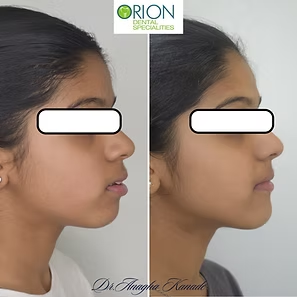
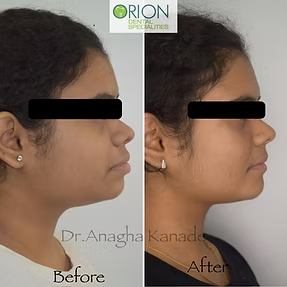
In some cases, especially where extractions are part of treatment, the profile becomes slightly less pushed out. This is most noticeable in patients who begin treatment with protruding front teeth. At Orion Dental Specialities, we plan for this with a case-by-case profile analysis before treatment starts, so you know in advance what to expect.
Your smile aesthetics
Straight teeth change your smile arc — the way your smile curves across the face. A well-designed smile arc fits the rest of your facial features, which is why a properly aligned smile can make the whole face look more balanced, even when the actual change is in the teeth alone.
What Braces Cannot Change
And here is where social media oversells it.
Your bone structure
Braces move teeth within the bone, not the bone itself. The American Association of Orthodontists is clear on this point: orthodontic appliances work on the teeth and their supporting structures, not on adult facial bones. Underlying features such as cheekbones, jaw width, and chin size are not changed by braces in adults. Only orthognathic surgery, which is jaw surgery, can change the bone structure itself in an adult.
There is an important exception for children. In kids under 12 to 15 years of age, some facial changes can be brought about by myofunctional appliances. These are specialised orthodontic devices that work alongside natural jaw growth, and they are prescribed by an orthodontist after studying the individual case and requirements.
Your fundamental face shape
If you have a round face, it will still be a round face after braces. If you have a square jaw, it will still be square. Braces change the smile frame within your face, not the overall shape of the face itself.
Your skin, age, or fat distribution
Braces do not slim cheeks. If a patient notices a slimmer face during treatment, it is usually due to lost weight in the first few weeks when eating feels harder, not from the braces themselves.
Can Braces Fix an Asymmetrical Jaw or Face?
“Can braces fix asymmetrical jaw?” and “can braces fix asymmetrical face?” are two of the most searched questions on this topic. The honest answer depends on where the asymmetry is actually coming from.
• Dental asymmetry, where the teeth are out of line. Braces can absolutely fix this. Crowded or shifted teeth are a leading cause of what looks like a crooked smile, even when the underlying jaw is perfectly symmetrical.
• Mild skeletal asymmetry. Some cases can be corrected or camouflaged with braces alone, particularly in growing teens where the jaw is still developing and responsive to guided orthodontic treatment.
• Moderate to severe skeletal asymmetry. These may need orthognathic surgery combined with orthodontic treatment. Braces alone cannot reshape the jawbone.
• How do you know which category you fall in? A clinical exam plus a cephalometric X-ray tells us exactly where the asymmetry originates — teeth, jaw, or both. This is not something you can diagnose from a selfie or an online quiz.
If you are unsure, an in-person consultation is the only honest way to get an answer that applies to your case. Generic online content cannot tell you what is right for your specific situation.
Real Changes We See at Orion Dental Specialities, Kothrud
In my practice, the most common “face change” cases fall into three patterns:
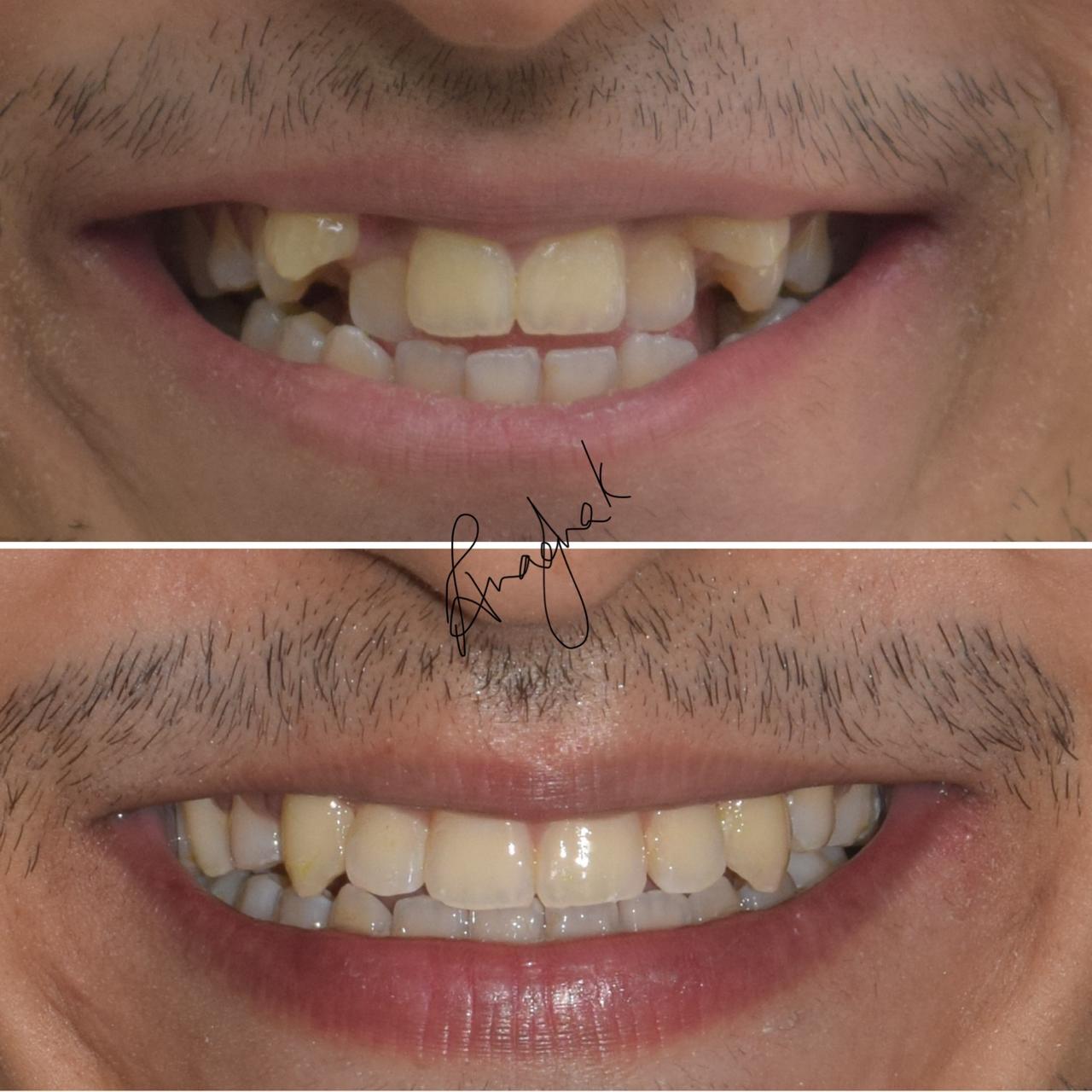
• Severe crowding cases. Patients arrive with overlapping or rotated front teeth and often a narrower-looking smile. Once the teeth are aligned, the lip support improves and the smile widens visibly in photographs.
• Overbite cases. Here the upper teeth sit too far forward of the lower teeth. Correction brings the lower jaw into a more balanced position, which subtly softens the profile and chin area.
• Gap closure cases. Closing large midline gaps often changes how the lips rest at the front of the face, and patients notice their mouth looks more “settled” once treatment is complete.
How Long Before You See a Change in Your Face?
• Months 1 to 3: teeth start moving. Face changes are usually not yet visible.
• Months 3 to 6: lip support changes become noticeable. Family often notices first.
• Months 6 to 12: smile aesthetics transform. For bite-correction cases, profile changes begin to appear.
• Months 12 to 24: the final tooth position settles. The face looks its balanced, finished result.
• After retainers: the result holds long-term if retainers are worn as advised.
3 Myths About Braces and Face Shape, Busted
Myth 1: “Braces give you a chiselled jawline.”
Reality: braces do not add bone to the jaw. A sharper jawline look in braces before and after jawline photos usually comes from weight loss, age-related changes, or better lip and bite alignment — not from braces creating new bone.
Myth 2: “Braces make your cheeks hollow.”
Reality: this is a temporary impression from reduced eating during the first few weeks as the patient adjusts to the braces. Once normal eating resumes, cheeks return to their usual fullness.
Myth 3: “Braces permanently reshape your face.”
Reality: the face changes are real but modest. They come from teeth being in the right place, giving the lips, jaw, and bite natural support. If the teeth move back because retainers are not worn, the face change can reverse too. That is why retainers matter as much as the braces themselves.
Thinking About Braces? Here’s What to Do Next
Every case is different. What braces can do for your face depends on your starting point, your goals, and your bone and bite structure. A consultation at Orion Dental Specialities includes:
• A full orthodontic exam with Dr. Anagha (our orthodontist)
• A digital scan and profile analysis
• An honest discussion of what braces can and cannot do for your face
• A clear treatment plan if you decide to go ahead
Frequently Asked Questions
Do braces change your jawline?
Yes, but subtly. Correcting a bite changes how the lower jaw sits, which can affect how defined the jawline looks in profile. Braces do not add bone to the jaw, so the dramatic jawline transformations seen in some viral videos actually need surgery or natural growth changes in children, not braces alone.
Will my face look slimmer with braces?
Not directly. Any slimmer face during treatment is usually from eating less in the first few weeks as you adjust to the braces, or from gradual weight change over 12 to 24 months of treatment. Braces themselves do not remove facial fat or reshape cheeks in any structural way.
Can Invisalign change face shape too?
Yes, for the same reasons braces can. Invisalign and braces both move teeth, so the face changes that follow from proper alignment are the same with both systems. The main difference is in how the treatment looks during the process, not in the final result.
Can braces fix a weak chin?
Partly, if the weak chin comes from a retruded lower jaw that can be improved by bite correction. True skeletal deficiency of the chin bone itself needs surgery or a chin implant, not braces alone. An orthodontist can assess which category your case falls into with a proper clinical exam.
How long until my face starts to change after getting braces?
Most patients notice changes in lip support and smile between months 3 and 6. Profile and jaw changes, where relevant, become clearer around months 6 to 12. The full final result settles by the end of treatment, usually 12 to 24 months depending on case complexity.
The Bottom Line
Braces make real, visible changes, mostly to the smile, lip support, and bite. What they will not do is reshape the underlying bone in adults. For most adult patients, the honest result is “a more balanced face,” not “a new face.”
If you want a straight answer about what braces can realistically do for your face, I would love to see you at Orion Dental Specialities in Kothrud. No sales pitch — just a clear, honest assessment of your specific case